Wednesday, April 15, 2020

Better Than Perfect


File:Armando Galarraga pitching 2010.JPG

June 2nd, 2010. Detroit's Comerica Park. Tigers right-hander Armando Galarraga throws a nasty breaking ball that Cleveland Indians batter Jason Donald slaps to the right side. Tigers first baseman Miguel Cabrera runs to his right, fields the ball cleanly and throws to Galarraga covering first base. They've practiced this play thousands of times. They execute it flawlessly. As Galarraga catches the ball and steps on the bag, Cabrera jumps high in the air to celebrate the rare and precious thing that just happened.
Except, it didn't happen. But something better eventually did.
Some context:
A pitcher throws an official "perfect game" if he pitches a minimum of 9 innings, earns a victory, and no opposing batter reaches base. As of June 2nd, 2010, only 20 perfect games had been thrown in Major League Baseball's 140-year history. On average, that's one perfect game every seven years, although there had been stretches of 23 and 33 consecutive years without a single perfect game. No Detroit Tigers pitcher had ever thrown a perfect game.
Galarraga's pitch to Donald came in the top of the ninth inning, with two outs. The Tigers led 3-0. Galarraga had retired the first 26 batters he faced. Cabrera was celebrating because once Donald was called out at first base, Galarraga would become the 21st pitcher in the history of the major leagues to throw a perfect game, and the first Detroit Tiger to do so in the team's 110-year history.
Alas, it was not to be.
Jim Joyce, umpiring at first base that day, called Donald safe at first base.
Here's the play:


Everyone on the field, everyone in the stands, and everyone watching on TV knew it was a bad call. Donald should have been out. Under today's replay rules, the call would have been challenged and overturned, Galarraga would have become the first Detroit Tiger ever to throw a perfect game, and Jim Joyce would have been off the hook. But these replay rules were four years away from being adopted. In 2010, there could be no challenge, so the game continued, with Donald at first base. Galarraga got the next man out to end the game and ended up with a complete-game one-hit shutout. But no perfect game.
Minutes after the game ended, Joyce saw the replay. He only had to see it once to realize he had blown the call. He was devastated. He immediately asked to meet with Galarraga. This was a highly irregular act. Umpires don't meet with players. Nonetheless, Tigers president/general manager Dave Dombrowski personally escorted Galarraga from the Tigers' clubhouse to the umpires' room. Galarraga walked up to Joyce, embraced him and said, "We are all human." Joyce, crying, apologized in English and Spanish (Galarraga is Venezuelan) and left the room, unable to speak any further.
Later, Galarraga said to the media, "[Joyce] probably feels more bad than me. Nobody's perfect. Everybody's human. I understand. I give the guy a lot of credit for saying, 'I need to talk to you.' You don't see an umpire tell you that after a game. I gave him a hug."
Joyce, spoke (tearfully) to the media as well: "I just missed the damn call. ... And there's nobody that feels worse than I do. I take pride in this job and I kicked the shit out of that and I took a perfect game away from that kid over there who worked his ass off all night.... This was probably the most important call of my career and I missed it."
There is much more to this story. Like how the next day, Joyce was assigned to be the home plate umpire, and Leyland tasked Galarraga with delivering the Tigers' lineup card to Joyce, resulting in a tearful handshake and shoulder pat at home plate, acknowledged by the Comerica Park crowd with a warm ovation. Or how Joyce and Galarraga would go on to jointly write a book about the incident that would connect them forever.
But the essence will always be this:
  1. On June 2nd, 2010, Jim Joyce made a mistake that deprived Armando Galarraga of his rightful spot in the annals of Major League Baseball.
  2. Compassion, empathy, honesty, self-accountability, and sportsmanship ruled the day. Both men's reactions to the incident turned it from an unfortunate event into a shining example of humanity at its best.
A perfect game pales in comparison.


Attribution Note: This essay was inspired by this bleacher report article and includes background material from this Wikipedia article about Galarraga's near-perfect game and this book. The title image of Galarraga is by Arbitrarilyo.





Thursday, April 9, 2020

The Bridges of Orleans


Barbara Henry was born in Boston's West Roxbury neighborhood on New Year's Day, 1932. She attended the nearby Girls' Latin School, a richly diverse institution that engendered commonality without needing to teach it explicitly, and stamped out intolerance organically.
After college, Barbara taught in nearby Malden and Quincy, while taking graduate courses in history and government at Boston College. Yearning to visit the places she was learning about, she applied to teach the children of armed forces personnel serving abroad. She ended up at an Air Force base outside of Paris, where she met a dashing lieutenant, who took her back to his home, New Orleans, where they married.
Her love of teaching unabated, Barbara applied to the New Orleans school system, where she was accepted and assigned to teach first graders at the William Franz Elementary School. It was 1960.
Barbara Henry was in place. History awaited.
Ruby Bridges was born on September 8th, 1954, in Tylertown, Mississippi. As a child, she took care of her younger siblings, jumped rope, played softball, and climbed trees. When she was four years old, her family moved to New Orleans. It was 1960.
Ruby Bridges was in place. History awaited.
In its landmark Brown v. The Board of Education of Topeka, Kansas ruling in 1954 (just a few months before Ruby Bridges was born), the U.S. Supreme Court declared school segregation unconstitutional. Despite the federal ruling, many southern states, Louisiana among them, refused to enforce the new laws and zealously resisted integration. Still, in 1960, Louisiana was explicitly ordered to desegregate by a federal court. The Orleans Parish School board responded by requiring black students to pass an "entrance exam" in a transparent attempt to keep black kids out of white schools. To the school board's chagrin, six black children in New Orleans passed the entrance exam. Two of the six decided to stay at their old school. The district transferred three to a school named McDonogh No. 19. The remaining first grader, Ruby Bridges, was assigned to William Franz Elementary School.
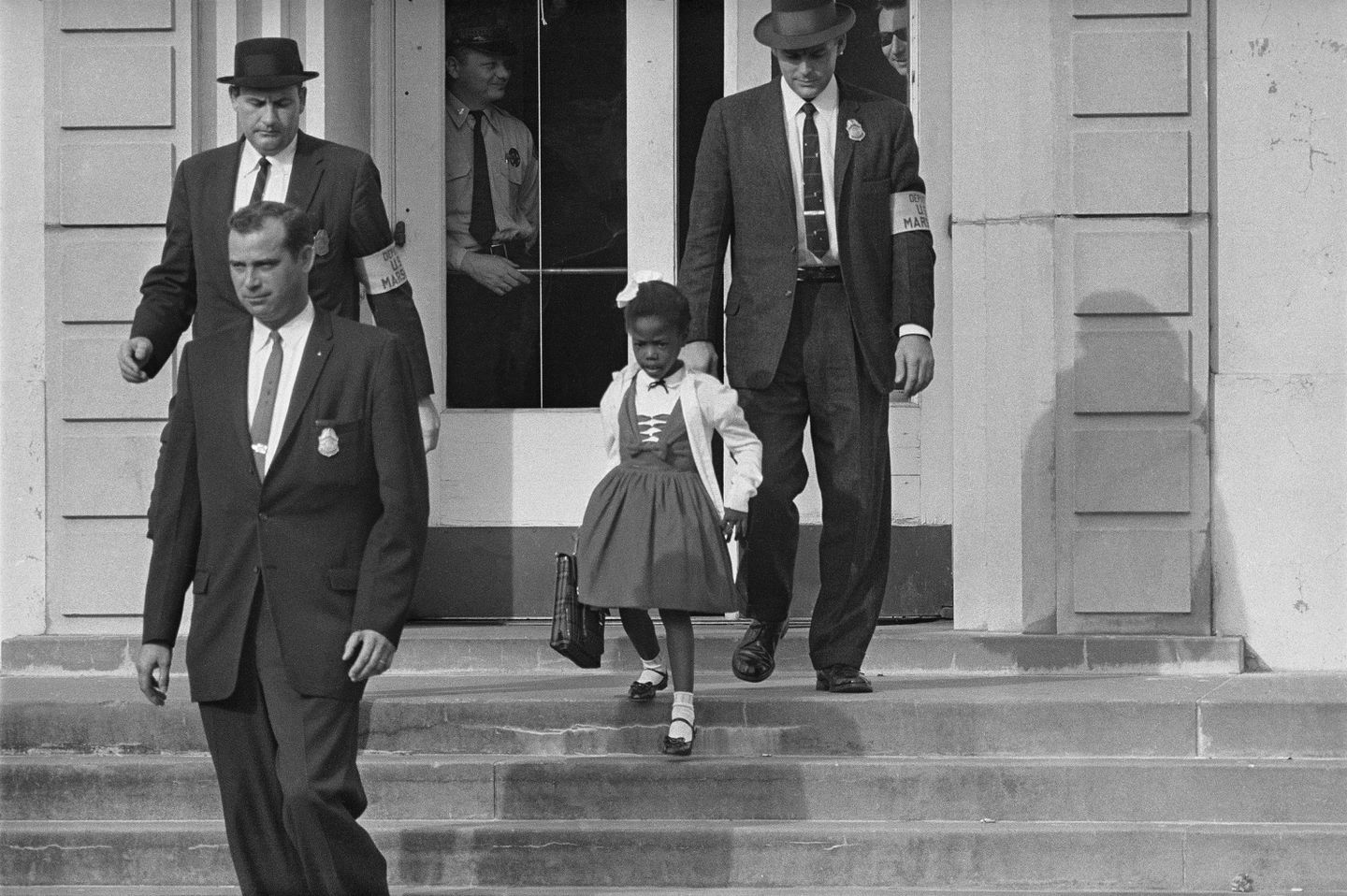
The federal court ruling required that schools in New Orleans be integrated by November 14th, 1960. On that day, 6-year-old Ruby, accompanied by her mother and four federal marshals (dispatched by President Eisenhower), walked to William Franz Elementary, making their way through large crowds of protesters throwing objects and yelling horrific racial slurs at her. Police were everywhere, but these were local cops, mostly sympathetic to the protesters, so they did little to quell their disgusting behavior.
When Ruby entered the school, white parents pulled their children out. Every single teacher at William Franz was white, and every single one of them refused to teach Ruby. Except one. You guessed it.
Barbara Henry.
During the entire school year, Barbara taught Ruby alone. Although white parents gradually began bringing their children back to school, no other children were allowed to join Ruby's classroom. It was just Ruby and "Mrs. Henry" (as Ruby would always call her, even as an adult), working on Ruby's lessons side by side at two desks. Ruby wasn't allowed to eat lunch with the other kids, so she ate with Barbara. Ruby wasn't allowed to play with the other kids at recess, so she played with Barbara. When she had to go to the restroom, the federal marshals walked her down the hall.
The marshals continued to accompany Ruby to and from school every day for the rest of the school year. And every day, she would encounter hatred. One woman repeatedly threatened to poison her, so the marshals allowed Ruby to eat only the food that she brought from home. Another woman held up a black baby doll in a coffin.
Yet Ruby did not miss one day of school that year.
In 1960, Ruby Bridges and Barbara Henry integrated William Franz Elementary. All by themselves.


Supplementary material:
Norman Rockwell's iconic painting, The Problem We All Live With, depicts Ruby walking to school with the federal marshals:
(Image from original uploader User:Jengod, Fair use, https://en.wikipedia.org/w/index.php?curid=601019)

Here's a photo of Ruby and the marshals, from the Boston Globe Magazine


Lastly, Ruby and Barbara on Oprah Winfrey's Where Are They Now program in 2014


__________________________________________________________________________
Attribution Notes:

This essay was inspired by a story told by Valerie Walker, live at The Moth. Background material for this essay was gathered from this biography.com article, this Women's History Museum entry, Ruby Bridges' Wikipedia page , Barbara Henry's Wikipedia page, and this Boston Globe Magazine article.

Tuesday, April 7, 2020

Rookie Robert


Robert, a right-handed pitcher, made his major league debut with the Cleveland Indians on July 9th, 1948. That evening the Indians were in St. Louis playing the Browns (which would, in 1953, become the Baltimore Orioles). Robert came on in relief of Bob Lemon in the bottom of the fourth, and pitched a pair of scoreless innings. He made seven more relief appearances that year, compiling a stellar 2.00 ERA. On August 3rd, he got his first start, against the Washington Senators, where he went seven innings, struck out six, and got the win.
Robert appeared in a total of 21 games in 1948, starting seven of them. He ended the year with a 6-1 record (with three complete games) and a 2.48 ERA. He even appeared in the World Series that year, helping the Indians win the championship, which to this day remains their last.
1948 was quite a promising rookie year for Robert.
But Robert's first year in the major leagues didn't engender excitement about his future. Instead, it gave rise to bittersweet thoughts of what might have been.
You see, when Robert walked onto the mound that first time in St. Louis, he was 42 years old, making him the oldest rookie in the history of Major League Baseball.  Because during the first 18 years of Robert's career, he wasn't allowed to play in the major leagues.
Robert's full name was Leroy Robert Paige, but he was known as "Satchel." And he was black. So he was relegated to playing in the detestably named Negro Leagues, where he compiled a career 146-64 record and a 3.10 ERA*. Paige was only able to join the major leagues after Brooklyn Dodger President and GM Branch Rickey signed Jackie Robinson in 1947, breaking the sport's color barrier.
Despite Paige's advanced age, he went on to pitch for the Indians again in 1949, and then for the Browns from 1951 to 1953, where he was twice an All-Star.
Regrettably, we'll never know what Satchel Paige's career would have looked like had he played in the major leagues during his prime, and that goes, of course, for all of his fellow Negro League players. I'll leave you with this from Mark Hauser, writing for Bleacher Report:
"Joe DiMaggio called Paige the best pitcher he ever faced (you would think he would know). Was Satchel the best pitcher ever? Was Josh Gibson the best home run hitter ever? Was James "Cool Papa" Bell (great nickname) the fastest player and the best base stealer to ever play baseball? How great an all-around hitter was Buck Leonard?
I do not have a definitive answer to any of these questions, and, sadly, neither does anyone else."


*The 3.10 figure was actually RA9, or run average per nine innings; basically ERA without the E, since that is what was customarily recorded in the Negro Leagues. Obviously, his proper NLB ERA, while unknown, was necessarily lower.

Attribution Note: Background material for this essay was gathered from this Society for American Baseball Research article, this Wikipedia page, this Baseball Reference page, and this Bleacher Report article.


Saturday, April 4, 2020

The Winklevii


We all remember this great scene from The Social Network:


Jesse Eisenberg and Andrew Garfield kill it, and the scene is delightful. But, you may ask, what exactly is the purpose of the third character, that guy whose only appearance in the movie was in this scene, and whose single line was, "Sweet"?
Please hold that thought.
One of the many things that The Social Network nailed was its casting. Eisenberg as Mark Zuckerberg, Garfield as Eduardo Saverin, Justin Timberlake as Sean Parker, Max Minghella as Divya Narendra, were all pitch-perfect. Everyone else in the movie shone as well; Rooney Mara as Erica Albright, Brenda Song as Christy Lee, and many others. I don't think anyone can even quibble with the casting of this movie.
Yet when it came to the strapping Winklevoss twins, Tyler and Cameron, casting became a challenge for director David Fincher, as he explained to Adam Markovitz of Entertainment Weekly:
"For a long time, I held out for this idea that we were going to find two 6'5" 220-pound scullers who were going to be able to act. So we looked and we looked and we looked and finally, probably about four weeks out from shooting, I just said, this is crazy. We’re never going to be able to get [it]. We need an actor. We need one person to play two people."
Indeed they found their one person: Armie Hammer, again perfect casting. Markovitz, in the same article, calls Hammer "an actor who shared both the Winklevoss’ build and high-society charm. (In real life, Hammer is heir to the Armand Hammer oil fortune.)"
So now Fincher faced the challenge of turning one actor into two characters.
Enter actor and model Josh Pence. Pence had read for the part of Tyler Winklevoss several times, and he finally got the part. What he didn't know, though, was that Fincher planned to use CGI (computer-generated imagery) techniques to pull off some magic. Pence signed up for one thing, and ended up doing something completely different. Fincher, again in his EW interview with Markovitz:
"I said [to Pence], 'Look, if you agree to do this, all the over-the-shoulders are going to be you, you gotta learn all the lines, you gotta be there for every shoot day. And when push comes to shove, I’m gonna lop your head off and put Armie’s head on you. It’s gonna be a completely thankless task.’ He’s so awesome. He said, ‘I’d love to do it.'"
Again, Fincher:
"Hammer played the main twin in each shot. For shots that included both twins at the same time, Pence stood in for the second twin; Hammer later went into a studio, where he strapped his head into a harness to film that twin’s face and voice, which was then digitally superimposed over Pence’s face in the film. The result is a sort of hybrid actor with Hammer’s head and Pence’s body."
So although Josh Pence's body appeared throughout the movie, his face never did, and he didn't utter a word.
Well, at least not while playing a Winklevoss.
We now circle back to the clip above. The cool, understanding dude in the stocking cap is none other than Josh Pence, for the first and only time with his own head on his shoulders. Fincher added that character to the scene just so that Pence's face and voice would forever be a part of The Social Network.
Sweet indeed.


Thursday, April 2, 2020

Broken Margarita


Born in Brooklyn, New York on October 17, 1918, Margarita Carmen Cansino was the oldest child of Eduardo Cansino, a Spanish-born Flamenco dancer who sexually abused her starting at a very young age. Margarita's mother knew of the abuse and began sleeping in the same bed as her daughter in an attempt to protect her, but the abuse continued unabated. By the age of 12, Margarita was overweight, emotionally stunted and unable even to play with other children.
In 1927, Eduardo moved his family to California in an ill-advised attempt to pursue a film career. Once he failed as an actor (his poor English was a factor), he began taking Margarita out of school and driving her to Tijuana, Mexico, where he would dress her provocatively, put garish make-up on her face, and put on dancing shows with her as his partner on casino stages. (He drove her into Mexico since child labor laws prevented her from working in the U.S.).
He told people she was his wife. The sexual abuse continued.
The year Margarita turned 18, she married Eddie Judson, 41, a lounge lizard and occasional car dealer. Judson repeatedly threatened her with physical abuse and disfigurement, and offered her body to any man he thought would advance his career.
Margarita's second husband, whom she married in 1943, was uncomfortable with her emotional needs and cheated on her regularly with prostitutes and other women. She married for the third time in 1949, but Margarita didn't fit in with her new husband's flamboyant lifestyle and exuberant friends. They divorced in 1953.
Later on that same year she married Dick Haymes, an Argentinian-born singer in the twilight of his career who had two bench warrants out for his arrest, one for unpaid alimony to one former wife and the other for unpaid child support to another. In addition, as he did not have proof of American citizenship, he was deemed an illegal alien and was in the process of being deported to Argentina. Margarita paid most of his debts and assumed responsibility for his citizenship, which allowed him to stay in the U.S. The marriage survived for two tumultuous years, ending when Haymes struck Margarita in the face in public at the Cocoanut Grove nightclub in Los Angeles. Margarita packed her bags and walked out, never to return.
Her fifth and last husband was James Hill, whom she married in 1958. In 1961 Margarita filed for divorce, citing extreme mental cruelty.
During the last decades of her life Margarita struggled with alcohol addiction. She was diagnosed with Alzheimer's disease in 1980, and died from complications related to it in 1987, at age 68.
Margarita's was a shockingly horrible life; that much is certain.
But there's more to her story.
The woman born Margarita Carmen Cansino:
  • Was married to Orson Welles (the nameless second husband above), and Aly Khan, an Arab prince (her third, the flamboyant one).
  • Was the top "pin-up girl" for GIs during World War II.
  • Was considered the most glamorous screen idol of the 1940s, and hence named "The Great American Love Goddess" by Life magazine.
  • Was called, by Fred Astaire, his favorite dance partner (sorry, Ginger).
  • Is listed as 19th on the American Film Institute's top 25 female stars of all time, between Shirley Temple (#18) and Lauren Bacall (#20).
You see, sometime in the late 1930s, Eddie Judson, the creep who you'll remember as Margarita's first husband, and Harry Cohn, the notoriously crude head of Columbia Pictures at the time, made Margarita dye her hair auburn and raise her hairline through electrolysis to broaden the appearance of her forehead. Cohn also considered her name "too Spanish-sounding," so he suggested she adopt her mother's maiden surname.
And so, Margarita "Rita" Cansino became... Rita Hayworth.
Here's one of her pin-up posters, the one immortalized by Stephen King in his 1982 novella, "Rita Hayworth and the Shawshank Redemption," adapted by Frank Darapont into the 1994 movie "The Shawshank Redemption." Here's her all-time signature scene, in 1946's "Gilda." And here it is again, as enjoyed by the inmates at Shawshank.
For decades, Rita Hayworth brought joy to moviegoers all over the world with her stunning, explosive on-screen charisma. Alas, that charisma belied the utter joylessness of her life off screen.
Perhaps the best way to wrap this up is to quote Susan Braudy's headline for her 1989 New York Times article about Hayworth:
“What We Have Here is a Very Sad Story.”


______________________

Attribution Note: The conceit of this post prevented me from initially linking to its source material, which consists of this Wikipedia article, this New York Times article (the one by Susan Braudy) , this biography.com article, and the AFI's Top 25 Female Stars list.