Sunday, June 11, 2017

He Gets a Pass


The following exchange took place during last June 2nd’s episode of Real Time with Bill Maher, where Maher was interviewing Nebraska Senator Ben Sasse:

Maher: “I’ve got to get to Nebraska more.”
Sasse: “You’re welcome.  We’d love to have you work in the fields with us.”
Maher: “Work in the fields…. Senator, I’m a house nig**r!”

Outrage ensued.  There were calls for HBO to cancel Maher’s show.  HBO condemned what Maher said, calling it “offensive” and “unacceptable.” The Rev. Al Sharpton, of all people, called Maher “disgraceful,” saying what he said was “outrageous,” and that Maher should be “held accountable.”  

Please allow me to refresh your memory with regard to the “outraged” Mr. Sharpton.  David Fagin, writing for The Huffington Post:

Those of us who grew up in the eighties remember Mr. Sharpton’s rise to “prominence” rushing to the defense of Tawana Brawley, an African-American teenager, who, back in 1987, falsely accused a local prosecutor, and others, of rape. Mr. Sharpton was found guilty of libel as a result of that case and ordered to pay $65,000.00.

Hank Berrien, writing for The Daily Wire:

When radio host Don Imus uttered what many thought was a racist comment in 2007, Sharpton called for him to be fired, saying, “You cannot allow the airwaves to become the toilet of racist language in America.”

Of course, when Sharpton used the ‘N-word” for other blacks, or called whites “crackers,” or Jews “diamond merchants,” or called gays “homos,” that was quite another story, apparently.

Or, even worse, as when Sharpton’s incendiary rhetoric helped incite the Crown Heights riots in which a Hasidic Jew was murdered.

Incidentally, Mr. Sharpton considers Mr. Maher a “friend.”  But, "he doesn't get a pass because we're friends."  (With friends like that…)

You know what, Rev?  Bill Maher does get a pass.  And not because we’re friends, although I would certainly be delighted to make Maher’s acquaintance.  But because, as you well know, Maher is not only not a racist, but is a liberal who calls out racism in other people.  And because all he did was make a joke (a natural, almost automatic comedic response to Sasse’s bizarre phrase) that included a word that is considered offensive when used by non-blacks (yet somehow OK when used by African Americans in all sorts of contexts), and then, not only did he issue a public apology, but apologized again and again during his next show on June 9th, and then listened contritely and held his tongue while being condescended to and patronized by sociology professor Michael Eric Dyson, rapper and actor Ice Cube, and activist Symone Sanders.   Such a squandered opportunity.  One (or more) of those three prominent African Americans could have easily transcended the bitterness that seems to pervade race relations (on both sides) now more than ever, and responded with grace and sensitivity to Maher’s heartfelt apologies, but, alas, Dyson, Cube and Sanders took the easy way out and simply trotted out the tired, destructive “us vs. them” bromides so tragically prevalent in our present day society.

Fagin continues:

Black, white, or purple, if you’re a believer in equality for all, you should absolutely be offended by the N-word. As, it represents a time, not that long ago, when inequality was law and the tragic mistreatment of an entire race of people was, by and large, tolerated. But it also needs to be judged in context. Is it being used to degrade a person or a nationality, such as when it’s painted on a prominent athlete’s front door, or used as term of condescension, say, by our current Attorney General? Or, is it being used to make fun of oneself in a comedic punchline? As in the context of how Maher, and a million black comedians before him, used it. What would have been the reaction if a Chris Rock, or a Richard Pryor, or Bernie Mac said it? Would there have been any reaction at all? At the very least, I doubt Al Sharpton would have uttered a peep.

I think the N-word needs to be, like Fagin says, “judged in context” no matter who utters it.  But right now, we have a situation where it is permissible for African Americans to use it, even in a tasteless or degrading manner, but it is not permissible for non-blacks to use it in any way whatsoever.  As Ice Cube said to Maher during the June 9th show (as quoted by Variety’s Sonia Soraiya):

“It’s a word that has been used against us — it’s like a knife. It can be used as a weapon, or it can be used as a tool. And it’s been used as a weapon against us by white people,” Cube said. “That’s our word now, and you can’t have it back,” he added.

That’s the issue. It’s “our” word now.  Fagin again:

For as long as I can remember, the N-word’s been, not only accepted by the black population, but embraced; in all forms of art, entertainment, and, most importantly, everyday speech. Whether it’s a ground-breaking Richard Pryor HBO special, a hilarious Chris Rock observation, a legendary NWA album - which, btw, proudly features the N-word in their name, a classic SNL skit, or a simple greeting amongst two friends, it’s been accepted, and even joked about, that, while white people are absolutely forbidden to even think about it, blacks can say it anytime, anywhere, in any context, and, for some reason, it’s perfectly fine.

This dichotomy is divisive, and perpetuates the N-word’s evil power to degrade and offend.  For the word to truly lose its venom, it must be permissible for everyone to use it in the proper context.  I’m not sure if we’ll ever get there.  As I wrote, in November of 2013:

I don’t know if the N-word will ever become an inoffensive part of our mainstream vocabulary, and I don’t know if the swastika will ever symbolize anything other than hatred.  But I do hope both things happen someday.  Because words and symbols have no power unless we bestow it upon them, and what we can bestow, we can remove.  If those victimized by the N-word and the swastika are somehow able to sap their evil, then maybe we would be closer to having moved on from those particular atrocities, and the heinous connotations of that word and of that symbol would become relics of a bygone era.

Given the relentless race-baiting of Al Sharpton and his ilk, the intransigent bitterness of Ice Cube and his ilk, and the barely under the surface racism and intolerance of our current President and his ilk, we have a long way to go.

In the meantime, I’ll leave you with Fagin’s brilliant concluding paragraph:

... if we, as well as the media, were as quick to condemn with fury and outrage the actions of those around us, as we are the words spoken by a few comedians, we probably wouldn’t have a pu**y-grabber as our president. Wouldn’t you agree, Sen. Sasse?

Indeed.


Tuesday, February 14, 2017

Just Wrong


While walking down Lincoln Road yesterday morning I came across two orthodox Jewish women who were obviously wearing wigs.  That night, I saw the terrific movie “Hidden Figures.”  The juxtaposition was jarring.  I’ll try to explain why.

“Hidden Figures” expertly evoked outrage at the normalcy with which mid-twentieth century Americans accepted repulsive things like separate bathrooms for African Americans and shockingly sexist, patronizing attitudes toward women.   We find it difficult to believe that good people stood idly by while those things were going on, and have no respect for those attitudes, because they are simply reprehensible.  The fact that they were considered “normal” at that time does not justify them in any way.  It was wrong, period.

Yet when sexism and discrimination don the cloak of religious custom, they somehow become sacred cows, exempt from criticism.  I go back to the Orthodox Jewish women.  From curiosity.com:

Because hair on the head is seen as a very beautiful symbol, it is covered to create privacy. Uncovered hair in the culture is equated to physical nudity. After marriage, many Hasidic Jewish women shave their heads as a symbol of fidelity and a way to denote they are off the market. Wigs are common for women with and without shaved heads, as it [sic] covers the head to create privacy and modesty.

I will leave aside the fact that it makes no sense at all to compel a woman to shave her head to not show her hair in public yet allow her to wear a wig, which if it is any good will make it seem like she is showing her hair in public.  Let’s just focus on the blatant sexism inherent in customs whose objective it is to mar a married woman’s appearance, while no similar custom applies to married men.  Why do we accept the shaved heads of Orthodox Jewish women, and the covered heads and bodies of religious Muslim women?  Because they're religious customs?  Because they've been around for thousands of years? Why does the religious context make sexism and discrimination OK?  

It doesn't.

Regardless of the origin of the custom or its longevity, forcing modesty and subservience upon women is just plain wrong.  It is absurd for religions to pretend that humanity is static and doesn't evolve over time.  It is pathetic to cling to outdated, offensive customs in a misguided attempt to persevere.

I am irreligious, yet I respect religious beliefs.  But I do not respect customs that are sexist, discriminatory, or demeaning to any group.  When I see an orthodox Jewish woman with a wig, or a Muslim woman wearing a burqa, I feel the same thing I felt when I saw the words “Colored Bathroom” on a door in “Hidden Figures.”

Revulsion.


(Photo: “Silk Burqa, 20th Century by Rama used under the Creative Commons Attribution-Share Alike 2.0 France license.)


Thursday, October 27, 2016

She


He was sitting alone at the bar, just finishing his tuna tartar, when the three women entered the restaurant.  Girls night out.  They also sat at the bar, to his right.  They engaged in non-stop conversation, paying him no heed as he continued to alternate his attention between “Top Gun,” showing on the TV screen on the left side of the bar, and “Chef,” on the right.

He could not help noticing, though, that there was clearly something special about the woman to his immediate right.  She was gorgeous, but it was more than that.  Her exotic beauty, combined with her natural elegance and grace of movement, made her profoundly alluring. She made everything (and everyone) around her fade away.  He was mesmerized.  Yet he didn’t want to appear rude, or interrupt the women’s conversation, so he didn’t approach her.  Yet.

Suddenly, there was an instant when the two women furthest from him were talking to each other, and she was momentarily disengaged.  Carpe diem.  He asked her what she was drinking, and remarked on her uncanny resemblance to the actress Angelina Jolie, bringing his friend Nunzio, the bartender, into the conversation.  They began to talk.

They talked about anything, and everything, with the ease of old friends.  They discovered all sorts of commonalities in their interests, values, and in their shared diversity of background.  She was intelligent, knowledgeable, and articulate (in two languages).  She listened as well as she spoke.  The default condition of her face was a smile, and she had an easy, delightful laugh.  Conversation hadn’t been so enjoyable and, well, fulfilling, in years. Many.  He had been mesmerized by her exterior.  Now, he was also enthralled by her interior.

They continued to talk.

Meanwhile the other two women, who had continued their one-on-one conversation, were ready to go on to the next bar on their schedule, just down the road.  She resisted, though, wanting to stay a bit longer.  He was feeling a bit guilty about disengaging her from her friends, but at the same time wanted nothing more than to continue to spend time with her, only her.  There was something he was beginning to fantasize about… but he didn’t allow himself to believe it was possible.

And then, it happened.

She told her friends to go ahead to the next bar, that she would stay with him, and that they might, possibly, meet up with them later.  


He will spend the rest of his life savoring that moment.  Hopefully, with her by his side.


Monday, October 10, 2016

Every Decade


Roughly every decade, Google CEO Sundar Pichai noted during a recent presentation, the paradigm changes.  From the desktop computer in the mid-80’s, to the web in the mid-90’s, to mobile in the mid-00’s.  

And now, to artificial intelligence (AI) in the mid-10’s.

Having used Google Now (hereafter known as Google Assistant) for a year or so, Mr. Pichai’s assessment rings true. Interacting with our “intelligent assistants,” in whatever context is appropriate to the situation, is the next logical step in personal technology.  And Google is uniquely qualified to lead the way.

Apple's Siri is limited by the company’s perhaps noble yet unavoidably constricting focus on user privacy, which keeps the information necessary for effective AI locked in each of their devices.  Microsoft's Cortana is neutered by Microsoft's failure in mobile.  And Amazon's Alexa (the AI in its Echo appliance), certainly a pioneer, is limited by its sole presence on the Echo, given the demise of its mobile phones.

Which leaves Google, which is in a unique position for two powerful reasons.  One, because it can make its AI available to users in any context: our computers, mobile phones (Android or iOS), and homes (via Google Home, Google’s upcoming take on the Amazon Echo).  And two, and most importantly, because all the information it needs to be effective resides in its inimitable cloud, so all devices are looking at the same, rich data.  

Google knows more about the world than anything (or anyone) else, and so the Google Assistant is already vastly better at providing universal information than any of its competitors.  Just tonight, I asked my phone, “OK Google, who is the chief of staff.” My phone responded, immediately, out loud, “Chief of Staff Denis McDonough. Denis McDonough is currently serving as President Barack Obama's Chief of Staff, a position he assumed in February 2013.” Just for the hell of it, I asked Alexa the same question.  “I don't know,” she said, “but check out the links I added to your Echo app.”  That's not going to do it, Alexa.

But just as Google knows more about the world than anyone, it also knows more about me than anyone.  Google can just as easily identify what my next calendar item is as it can identify Denis McDonough.  During the past year, Google Now has delighted me by doing things like using my calendar entries, my location and traffic conditions to automatically remind me that it’s time to leave to make it to my appointment on time.  

Pichai, during the same presentation:

Just like we built a Google for everyone, we want to build each user his or her own individual Google.

So, Google knows everything about the world.  It knows everything about me.  And its knowledge is available to my mobile phone, my computer, my home, and whatever future devices come along, as long as they have an internet connection.  Google is, therefore, uniquely positioned to interact with me in an intelligent way.  And it does. But this is only the beginning.

Google’s assistant will not only retain, process, analyze and return information, it will also help users get things done efficiently by becoming a ubiquitous intermediary, just like a good human assistant.  Google’s linking of its assistant with external companies’ systems enables actions such as, “OK Google, get me an Uber,”  “OK Google, dim the living room lights,”  “OK Google, play my dinner party list on Spotify.”  And so on.

Bottom line: if Mr. Pichai is right (and I really think he is), and AI is the next paradigm, Google is uniquely qualified to succeed.  

And the future could not be in better hands.


(Photo: “The famous red eye of HAL 9000” by Cryteria, used under the Creative Commons Attribution 3.0 Unported license.)


Tuesday, September 27, 2016

One Six


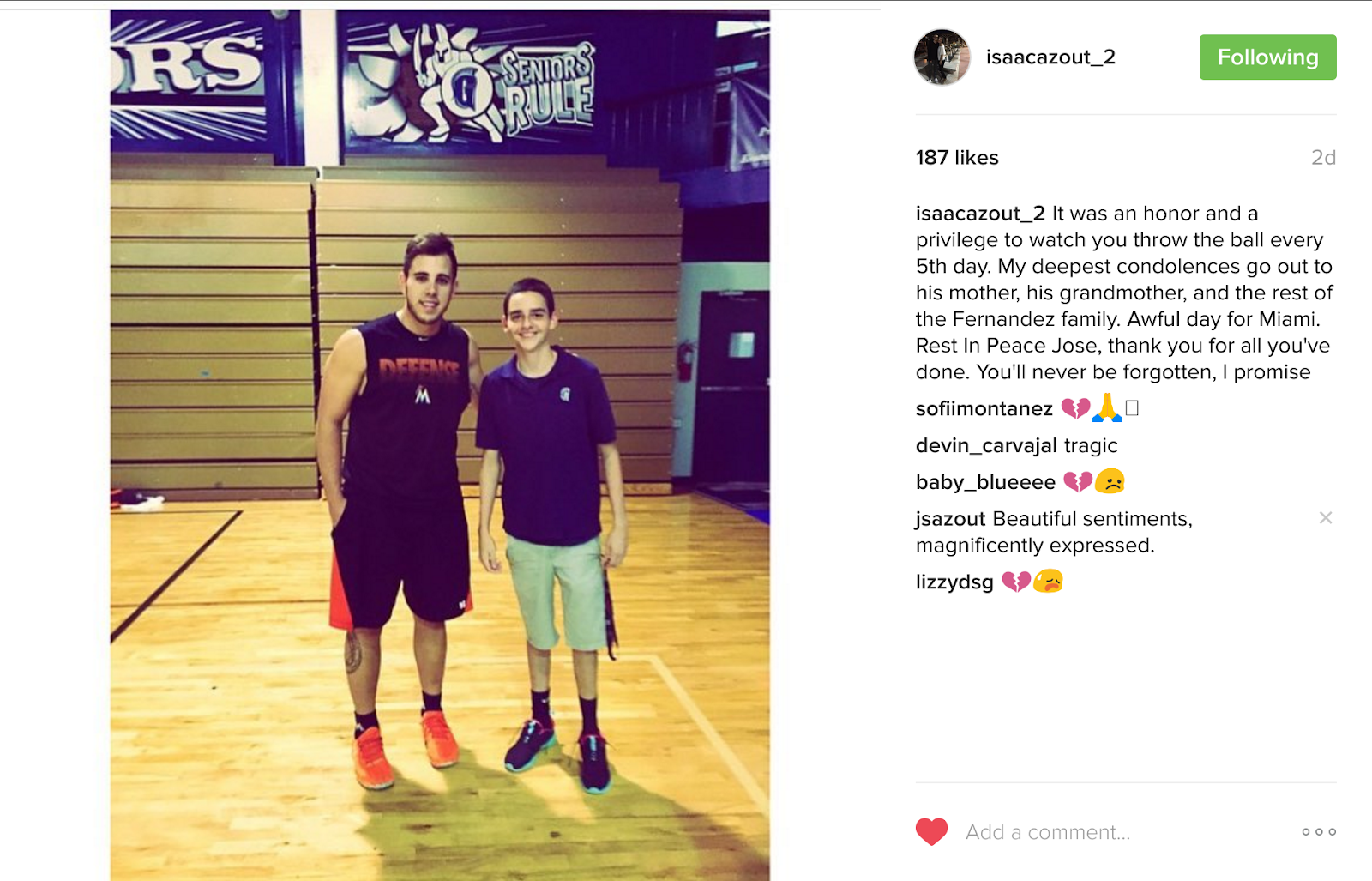
José Fernández, right handed starting pitcher for the Miami Marlins, already a star and considered to have one of the most promising futures in all of major league baseball, was killed, along with two of his friends, in a boating accident off Miami Beach early Sunday morning.   He was 24 years old.  

José was the living definition of joie de vivre.  His exuberance was uncontainable; his love for his family, teammates, and for the game of baseball were in constant evidence.  His life story is the pure embodiment of the American Dream.

And so...

Every single Marlins player, along with Manager Don Mattingly, President David Samson and President of Baseball Operations Mike Hill, crowded into the room where they held the heart wrenching press conference just a few hours after the the overturned boat, along with the three bodies, was discovered at 3:30am Sunday.

After the press conference was over, the entire team piled into buses (one of them graciously provided by the Atlanta Braves, who were still in town for the last game of their series with the Marlins, which was to be played on Sunday, but was, of course, cancelled) and spent the entire afternoon at the home of José’s mother, comforting her, José’s grandmother, and his pregnant girlfriend.

Once it was time to play baseball again, on Monday night against the New York Mets, every single Marlins player, coach and manager wept openly, before, during and after the game, unashamedly displaying their love for their fallen brother.

Every Marlins player, coach and manager wore the Marlins’ normal black jersey, except all of them had José’s number (16) and last name on their back.  I don’t know of this ever taking place before, except for the annual Jackie Robinson celebration, where everyone in Major League Baseball wears Robinson’s number 42.

Prior to the game, after the moment of silence to honor José’s memory during which the Marlins players circled the mound, the Mets players came out of their dugout and tearfully embraced the Marlins players, something that had not happened since these same Mets were similarly consoled by the Atlanta Braves on the first game played in New York after 9/11.

Dee Gordon, the Marlins’ left handed leadoff hitter, took the first pitch of the game from the right side of the plate, imitating José’s immediately recognizable batting stance.  He then switched to his natural left side.  Two pitches later, he hit his first home run of the season, tearfully circled the bases and broke down in the dugout.

The Mets taped a Mets jersey with number 16 and the name Fernández on the back, on their dugout wall.  It said, you are one of us.  You are our brother, as well.

At the end of the game (the Marlins won, 7-3), the Marlins players again circled the mound, and, in another impromptu tribute, left their hats on the mound in honor of José.

I posted this:

Screenshot 2016-09-27 at 3.54.50 PM.png


My son posted this:

Screenshot 2016-09-27 at 3.58.18 PM.png


And so it goes.  We all knew José was going to become a legend someday.

Just not so soon.


Monday, September 19, 2016

Welcome to America


Regarding the arrest of Ahmad Khan Rahami, the suspect in the bombings across New York and New Jersey over the weekend, Donald Trump:

It’s a good thing authorities caught this evil thug.  The bad part now is we will give him amazing hospitalization.  He will be taken care of by some of the best doctors in the world, he will be given a fully modern and updated hospital room, and he'll probably even have room service, knowing the way our country is.  On top of all that, he will be represented by an outstanding lawyer.

In response, New York Gov. Andrew Cuomo:

Welcome to America. We have a system of jurisprudence. You're innocent until proven guilty, you have a right to counsel, you have a right to hospitalization if you're ill, that is our system, and that is what makes this country special and what makes this country great.  The government can make mistakes, and that's why we have trials. I don't know what the alternative would be, unless you thought government on its own belief is the judge, jury, and executioner all in one.

This is the choice we face.  Enough said.