Thursday, November 15, 2018

Nested Irrationality


As an irreligious person, the earnest belief in religion is difficult for me to fathom, yet fascinating.  I’m even more fascinated by those aspects of religion that make no sense, even within their nonsensical premise.  A quick example from Wikipedia’s page regarding the Jewish holiday of Passover:


In the narrative of the Exodus, the Bible tells that God helped the Children of Israel escape from their slavery in Egypt by inflicting ten plagues upon the ancient Egyptians before the Pharaoh would release his Israelite slaves; the tenth and worst of the plagues was the death of the Egyptian first-born.


The Israelites were instructed to mark the doorposts of their homes with the blood of a slaughtered spring lamb and, upon seeing this, the spirit of the Lord knew to pass over the first-born in these homes, hence the English name of the holiday.
So God, purported to be omniscient throughout the Bible, still required the Israelites to mark their homes so he would know to pass them over.  To make sure he didn’t screw up?  Makes no sense, even accepting the nonsensical premise.  If you believe in God’s omniscience, the marks on the doors cannot make sense to you.  I’m going to call this irrationality within a larger irrationality a nested irrationality.


A much wider, and perhaps even more ludicrous example of a nested irrationality is the Bible itself, taken as a whole.  A Gallup poll conducted last year found that 24% of Americans believe that the Bible is "the actual word of God, and is to be taken literally, word for word," while another 47%, although they do not believe all of it should be taken literally, still believe it to be “the inspired word of God.” So, quoting Gallup, “the vast majority of Americans -- 71% -- continue to view the Bible as a holy document, believing it is at least God-inspired…”


Please consider these quotes, all from this “holy” document (this handy website returns the text of any chapter and verse, in case you want verify any of them):


Whoever does any work on the Sabbath day is to be put to death. (Exodus 31:15)


Do not plant two kinds of seed in your vineyard; if you do, not only the crops you plant but also the fruit of the vineyard will be defiled. (Deuteronomy 22:9)


Anyone who blasphemes the name of the Lord is to be put to death. The entire assembly must stone them... (Leviticus 24:16)


If a man has sexual relations with a man as one does with a woman, both of them have done what is detestable. They are to be put to death; their blood will be on their own heads. (Leviticus 20:13)


Slaves, in reverent fear of God submit yourselves to your masters, not only to those who are good and considerate, but also to those who are harsh. (1 Peter 2:18)


If a man beats his male or female slave with a rod and the slave dies as a direct result, he must be punished, but he is not to be punished if the slave gets up after a day or two, since the slave is his property. (Exodus 21:20-21)


I do not permit a woman to teach or to assume authority over a man; she must be quiet. (1 Timothy 2:12)


Wives, submit to your husbands as to the Lord. (Ephesians 5:22)


Now go, attack the Amalekites and totally destroy all that belongs to them. Do not spare them; put to death men and women, children and infants, cattle and sheep, camels and donkeys. (1 Samuel 15:3)


The quoted passages are consistent with the belief that the Bible is simply a collection of antiquated writings that may have historical value, but not much else.  The passages present no issue even to believers in a higher power, as long as they don’t ascribe divinity to the Bible. But the 71% of Americans who believe that the Bible consists of God’s words, or words inspired by God, are caught in a nested irrationality.


That is, unless they consider God an ignorant, vain, tyrannical, sexist homophobe who condones slavery and promotes genocide.



Friday, May 18, 2018

In Response to Ms. Lang


Michelle Lang, a lifelong, dear friend of my daughter, recently commented on my post, Behind the Curtain.  Although judging from her observations it seems Michelle and I have differing views with regard to the current administration, I know Michelle to be intelligent and thoughtful, and I respect her opinion, so I thought it appropriate to respond to her comments here.  Michelle’s comments (including her quotes from my post) are shown in blue below.

"So, Trump acknowledging Jerusalem as Israel’s capital is the fulfillment of a campaign promise to evangelicals, a promise that helped this despicable human being get elected President." False. The last 4 presidents AT LEAST have declared the same thing. People had no reason to believe Trump would follow through with it during the campaign when others had not. Not to mention that Jerusalem is Israel's capital not because the US declared because it's own country declared it.

Also it was passed as a law in 1995 by Congress that the US embassy was supposed to be moved to Jerusalem.

I dispute your contention that “People had no reason to believe” he would follow through.  I believe it likely that backroom deals were made. It is indisputable that Trump would never have gotten elected without the support of the evangelicals, and their hypocrisy in overwhelmingly supporting a person so antithetical to their own purported value system is stunning.  Trump and the evangelicals is the epitome of politics making strange bedfellows. Previous presidents have walked a fine line, trying to support Israel yet also trying not to sabotage the peace process. No such nuance with Trump. Bottom line: the evangelicals would not be engaging in these absurd moral gymnastics to attempt to justify their support of Donald Trump without a quid pro quo.

"During a tone-deaf event Monday" What exactly was tone deaf?

The juxtaposition of a tony inauguration event with the bloody confrontation taking place 60 miles away made it far too easy for the media to come up with headlines like “Daddy’s Little Ghoul.”  I’m not defending the headline, just pointing out that the situation made it inevitable.

"as described in detail in this article in The Guardian, and this one in Haaretz" You may want to use sources from both sides of the aisle or things will get very skewed.

Who would you have me quote, Fox News?  Granted, The Guardian and Haaretz are considered liberal publications, but they are also considered high quality sources.  I presented my point of view, and quoted reputable sources to help make my points. My post is an opinion piece, not news reporting.

"Trump chose two bigots to be featured in Monday’s ceremony." False. The person you are calling a bigot was simply expressing his beliefs "People that believe in Jesus will go to heaven, people that don't won't" The same way that Jews consider themselves "the chosen people"That is not bigoted, and using words like that so callously is not good.

The two people I called bigots are Rabbi Yitzhak Yosef and Robert Jeffress.  And I’d like to take this opportunity to, once again, call them bigots. Regarding Yosef, Margaret Hartmann writing for New York Magazine:

In March, Yosef was criticized by the Anti-Defamation League after using the term “kushi,” a derogatory Hebrew word for black people, in a sermon, and comparing them to monkeys.

“You can’t make the blessing on every ‘kushi’ you see — in America you see one every five minutes, so you make it only on a person with a white father and mother,” he said. “How do would you know? Let’s say you know! So they had a monkey as a son, a son like this, so you say the blessing on him.”

So he’s a racist as well as a bigot.

Regarding Jeffress, Hartmann again:

Jeffress, who runs the First Baptist Church in Dallas, has referred to Islam and Mormonism as “a heresy from the pit of hell.” He’s also claimed that Islam promotes pedophilia, called Catholicism the “genius of Satan,” and dismissed various other religions as cults. Unsurprisingly, he’s also denounced homosexuality as a “filthy practice” and vividly railed against the legalization of same-sex marriage.

Calling this guy “a bigot” is like calling Michael Jordan “a basketball player”.

Even Republican Mitt Romney joins me in calling Jeffress a bigot:

Robert Jeffress says “you can’t be saved by being a Jew,“ and “Mormonism is a heresy from the pit of hell.”  He’s said the same about Islam. Such a religious bigot should not be giving the prayer that opens the United States Embassy in Jerusalem.

To your point about expressing beliefs, I contend that a person who believes that “People that believe in Jesus will go to heaven, people that don't won't" is a bigot, as is anyone who considers people of any faith to be “chosen.”  

"So, the acknowledgement of Jerusalem as Israel’s capital is just Trump once more delivering on his pact with evangelicals, cleverly disguised as a show of support for Israel." False. It is a promise kept to both. He has absolutely showed his solidarity with Israel numerous times.

What Trump has shown numerous times is that he is a shameless panderer who will do whatever and say whatever, first to get elected and then to keep his approval rating high among his base.  Ideology, solidarity and values have nothing to do with it. It’s all about self-benefit, and self-aggrandizement, basically what Trump has been about his whole life. Regarding “solidarity with Israel,” please keep in mind that Jews globally are divided about the embassy move.  Many feel it will hurt Israel in the long run by hindering the peace process. I can certainly see both sides of that discussion. The only group unanimously in favor of the move is the evangelical community.

A little less emotion should be used, and sources from everywhere. This is misleading and comes off as hateful.

With due respect, I think I’ll choose the level of emotion to use on my own blog, thank you.  Regarding “sources from everywhere,” again, this is an opinion piece.  Think editorial.  I am not reporting the news.  You may disagree with me, or have a differing opinion, but I don’t consider anything on my original post to be misleading.  I don’t think I would describe my post as “hateful,” either.  However, it is demonstrable that Trump cynically exploited the latent hate in a particular segment of our population to come to power, and continues to exploit it every day to keep his political base happy.  

And I do “hate” what that is doing to my country.


Wednesday, May 16, 2018

Behind the Curtain


If there’s one thing you can be sure of with regard to the Trump administration, it’s that things are not what they appear to be.  Two recent examples: the US’s recognition of Jerusalem as Israel’s capital, and Trump’s recent tweets about saving Chinese technology firm ZTE.

First, Jerusalem.  Last December, Trump formally recognized Jerusalem as Israel’s capital, setting in motion a plan to move the United States Embassy from Tel Aviv to the fiercely contested Holy City.  During a tone-deaf event Monday, Trump administration officials, including first daughter Ivanka Trump, her husband and Trump advisor Jared Kushner, and Treasury Secretary Steven Mnuchin, officially opened the new US Embassy in Jerusalem along with Israeli Prime Minister Benjamin Netanyahu, and all of them (including Trump himself, who did not attend but sent a video message) characterized the policy change as a US show of support toward Israel and the fulfillment of a campaign promise.  Israel supporters around the world had mixed reactions, as moderates condemned the move, calling it an impediment to the future progress of peace negotiations, while Orthodox Jews and right-wing Israelis (including, of course, Netanyahu) lavished praise on both the move and their hero, the comically narcissistic Donald J. Trump.

There was one other group positively rapturous (pun intended) about the new home of the US Embassy: the absurdly hypocritical pro-Trump evangelicals.  Why, you may ask yourself, as I did when I first heard of this, would evangelicals be so fervently supportive of Jerusalem being officially acknowledged as Israel’s capital?  Because, as described in detail in this article in The Guardian, and this one in Haaretz, evangelicals believe that, per biblical prophecy, such acknowledgement is necessary for the second coming of Jesus Christ and the beginning of the Rapture, or end times.

So, Trump acknowledging Jerusalem as Israel’s capital is the fulfillment of a campaign promise to evangelicals, a promise that helped this despicable human being get elected President. Netanyahu (and other hardliners) were incidental beneficiaries.  As if to prove the point, Trump chose two bigots to be featured in Monday’s ceremony.

So, the acknowledgement of Jerusalem as Israel’s capital is just Trump once more delivering on his pact with evangelicals, cleverly disguised as a show of support for Israel.

Now the ZTE flip-flop.  Stephen Collinson, writing for CNN:

The Trump administration last month banned ZTE, which makes smartphones running Google's Android operating system, from using US technology after accusing it of violating a deal in which it agreed to pay $1.2 billion for evading US sanctions on North Korea and Iran.

Yet on Sunday, out of nowhere, Trump tweeted that "President Xi of China, and I, are working together to give massive Chinese phone company, ZTE, a way to get back into business, fast. Too many jobs in China lost. Commerce Department has been instructed to get it done!"

Why would Trump, who won power accusing China of stealing American jobs and has long vilified China for taking advantage of the US using unfair trade practices, now be lamenting the loss of Chinese jobs and championing ZTE?  Inexplicable, on the surface.  But I have no doubt that the ZTE reversal, like anything else done by this administration, was motivated by self interest and is the result of some shady backroom deal.  Although we know the true motivation behind the Jerusalem acknowledgement, we don’t yet (and may never) know the truth behind the ZTE U-turn. Summer Meza, writing for The Week, however, raises an interesting possibility:

President Trump's decision to help a Chinese telecom company bounce back from U.S. trade restrictions may have residual benefits for his family's company, Quartz reported Tuesday.

[snip]

Some are wondering whether the reversal will encourage Chinese businesspeople to work with the Trump Organization, the president's private company, reports Quartz. The South China Morning Post reported that a Chinese state-owned firm recently agreed to provide $500 million to fund a project that will build Trump-branded hotels and golf courses in Indonesia. The Trump Organization, which Trump still owns, could reportedly earn millions of dollars from the project.

Asked about the possible conflict of interest Monday, the White House said it would not comment on a private organization's business dealings.

Is the Trump administration truly a kakistocracy?  Or is it, instead, a shockingly corrupt regime, hiding behind a smokescreen of incompetence?

I’m beginning to think the latter.


Sunday, January 21, 2018

$10 and a Day


It’s become second nature to me, when experiencing a minor inconvenience, to turn to amazon.com to find a solution for it.  In some cases, there isn’t one, and in others, what appears to be a good solution just plain isn’t.  But more often than not, there is an excellent solution only a day away.

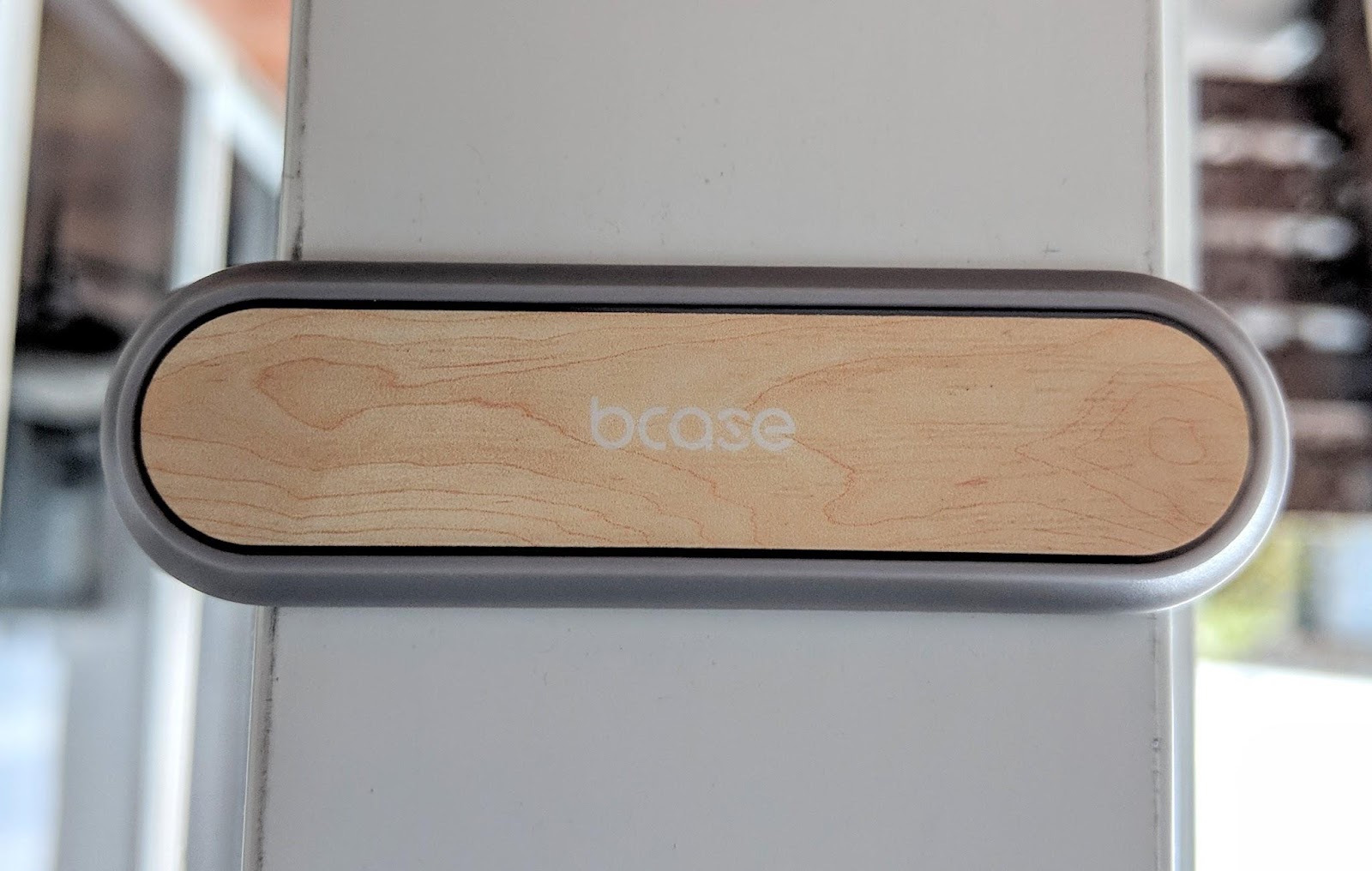
Case in point: the Bcase Magnetic Cable Clamps Desktop Cable Clips Organizer.  I know, not the catchiest of names, but the Organizer (I’ll just call it that from now on) is an elegant, thoughtfully designed, hassle-free and inexpensive cable organization system.

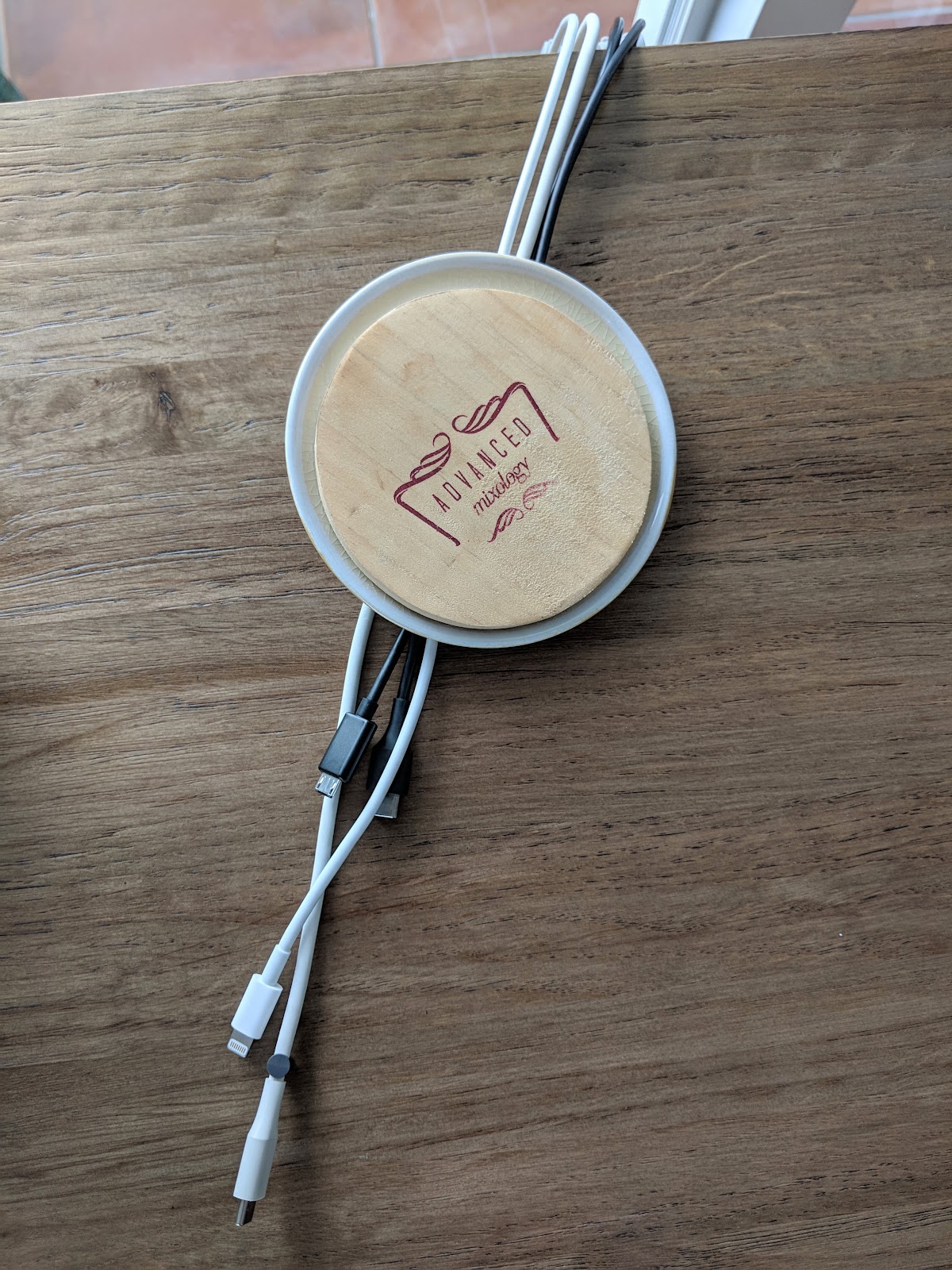
We all have various devices that need to be charged, and until wireless charging (or, more accurately, inductive charging) becomes pervasive and we charge our devices just by placing them on our desk or nightstand, we need to plug them into cables.  And when our devices are not being charged, the cables are just dangling there, looking ugly and at risk of sliding back and falling off the table, to our dismay when we need to plug our device back in. So we’ve devised creative ways of keeping the cables in place.  Mine was coaster-based:


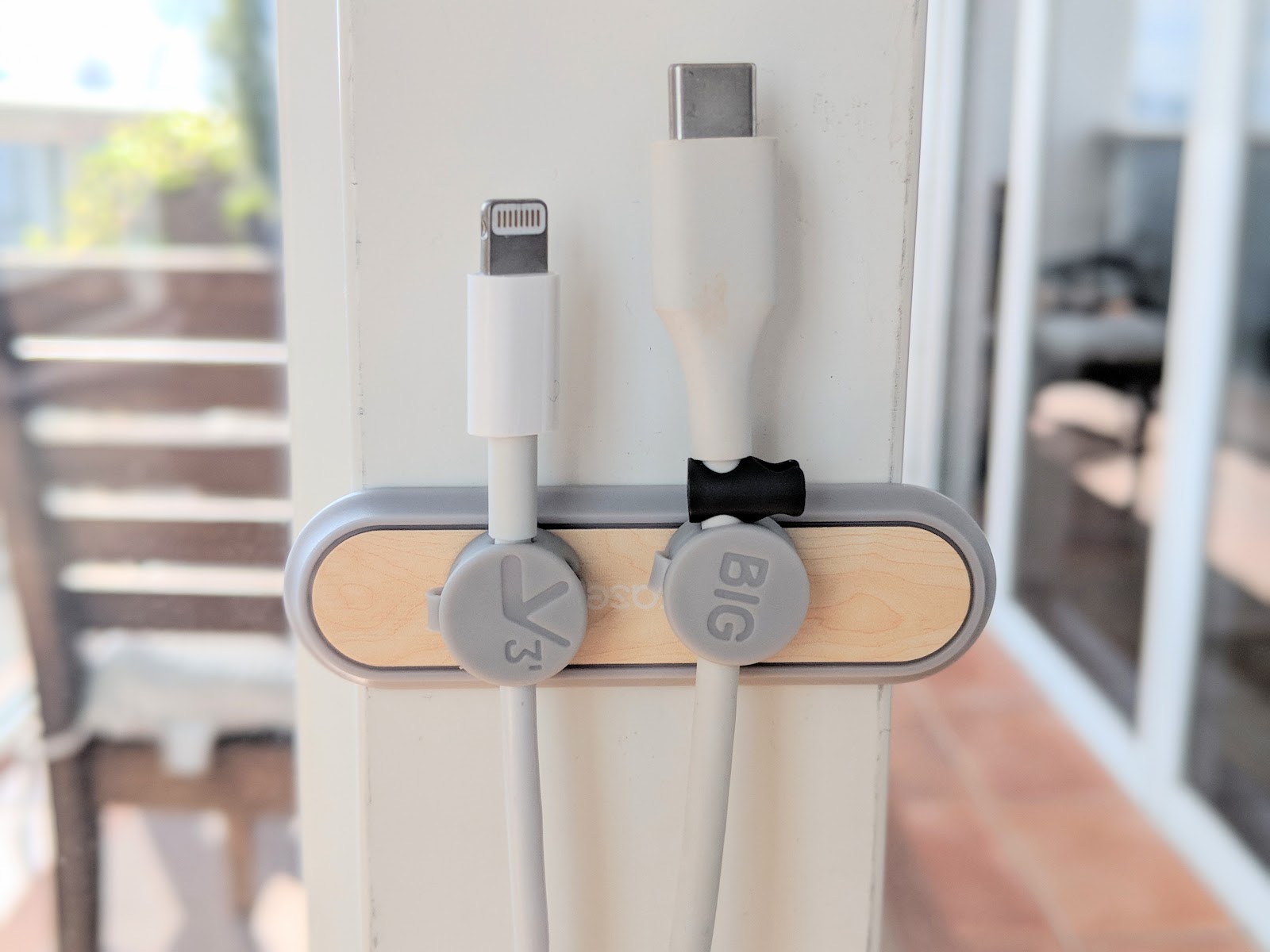
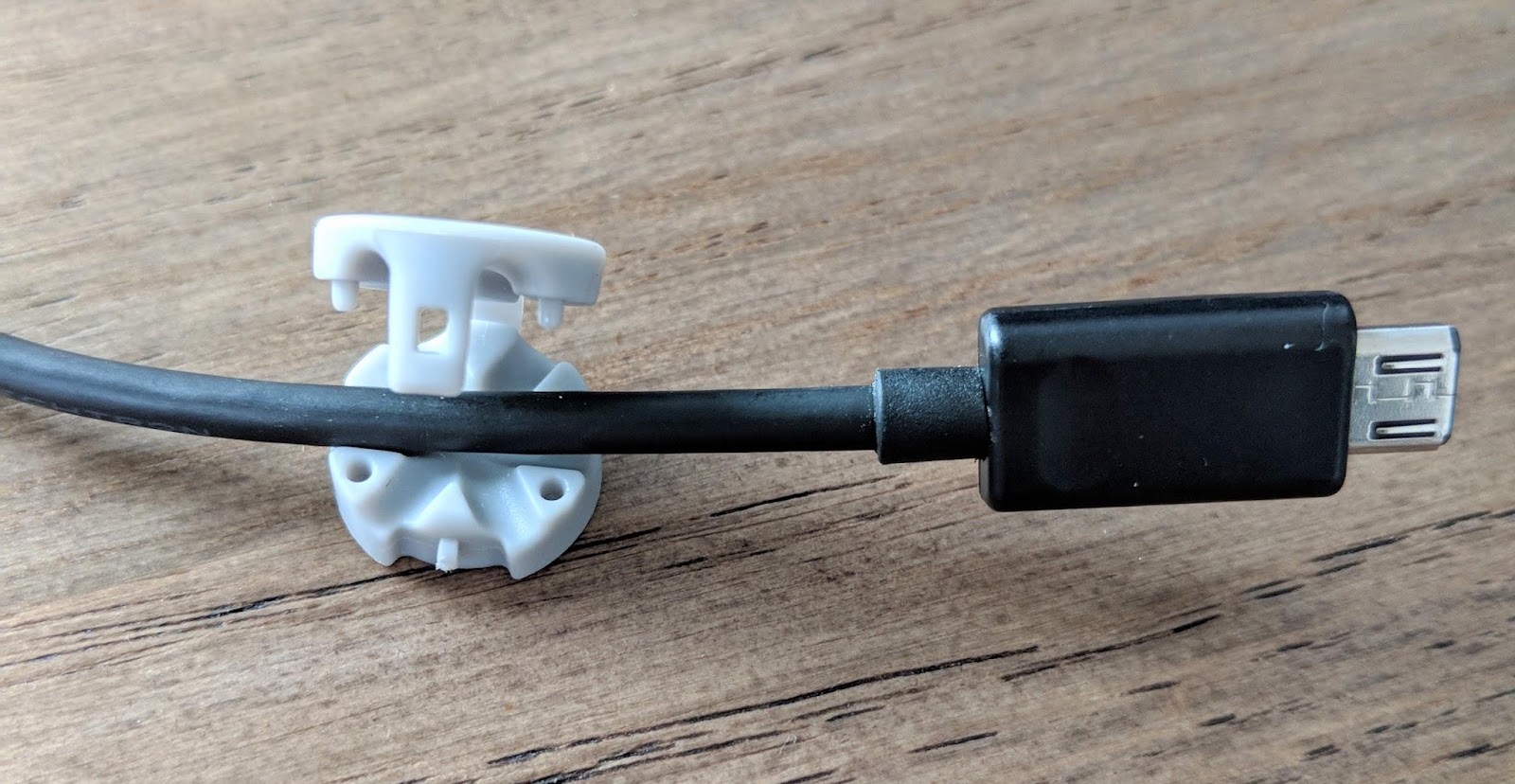
Enter the Organizer.  The system consists of two parts, an adhesive metal strip that you stick on any surface, and a circular, magnetic piece that clips around your cables:

This is the end result:


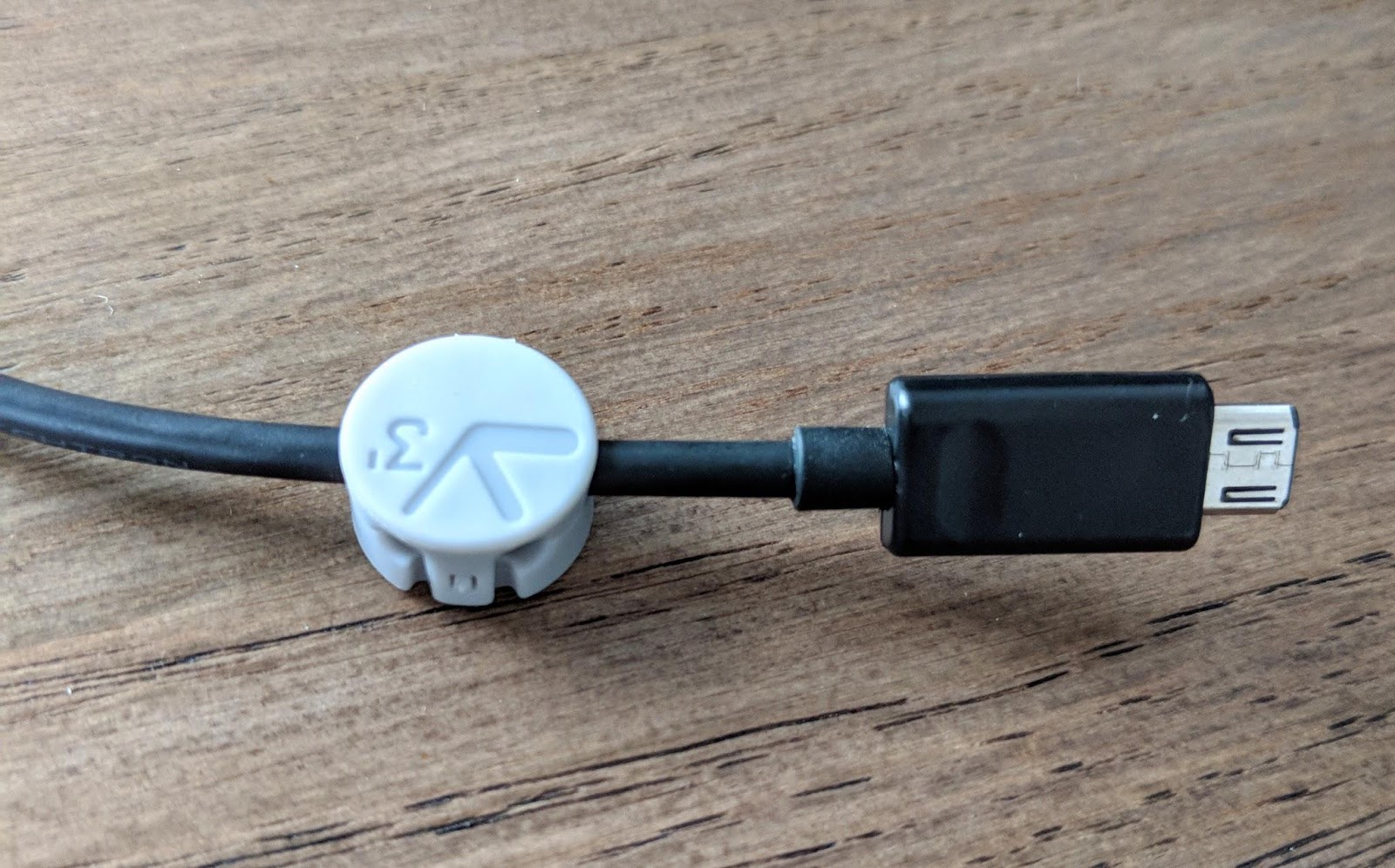
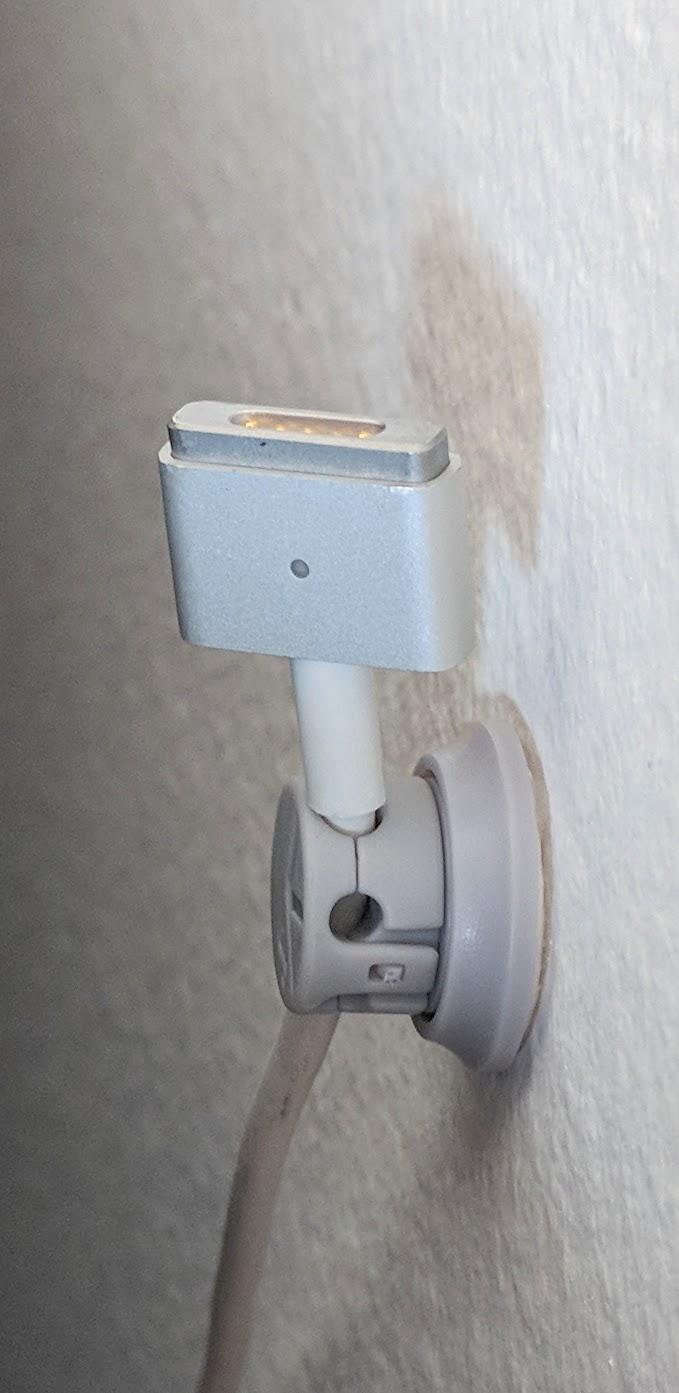
The kits I ordered each include the strip, two “regular” clips designed for thinner cables and one able to handle thicker cables, helpfully labeled “BIG.”  The regular clips fit around most of my cables, but the BIG clips came in handy for a couple of my USB-C cables, which are significantly thicker than their Lightning or micro-USB counterparts.  Both size clips can be magnetically attached to the strip, as shown above, and they can also be attached to their own adhesive circular metallic base, one of which is also included in the kit:


The strips and circular base can be adhered to any surface; the desk or nightstand itself, the wall behind it, etc., so your cables can be totally hidden from view, yet easily accessible when needed.  The clips easily unhinge and snap back into place, so installing them on cables is literally a snap, as is removing them.

Organizing charger cables is certainly a first world problem, and, relatively speaking, quite insignificant.  Yet every time I reach for one of my cables to plug in a device, or unplug a device and place the cable back on its strip, I’m reminded of how small things, seemingly insignificant things, can bring great joy.


Tuesday, January 2, 2018

Pixel Buds


The Google Pixel Buds are utterly frustrating.

They sound better than any in-ear headphones, wired or wireless, I have ever used.  Their rich and satisfying sound makes their competitors (Apple’s AirPods, JLabs’ Epic2 et al.) sound downright  tinny by comparison.  The microphone works shockingly well; I’ve had telephone conversations using the Pixel Buds, and the people at the other end have never even realized I was on Bluetooth.  And the Pixel Buds are comfortable enough to use all day.

But what sets the Pixel Buds apart is their “Googleyness.” The Google Assistant is just a tap away, similar to Siri on the AirPods, but much more capable.  Using that amazing microphone, through the Assistant you can instantly access your calendar, your music, navigation, the weather; all of Google, really.  It will read you your messages (SMS, email, WhatsApp, etc.) if you so desire.  And, when used with a Pixel phone, the Google Assistant is capable of instant translation, which works exactly as demonstrated at last year’s Google I/O conference.  Truly mind boggling.

So, why is this extraordinary product frustrating?  Because it does all of the foregoing, extremely difficult things, exceedingly well, yet totally falls down on some of the basic stuff.

The right earbud is the headset’s control center.  You tap it once to play/pause the audio (or video), or to answer or end a phone call.  Tap and hold brings up the Google Assistant.  Double tap to listen to your notifications.  A forward swipe increases the volume, and a backward swipe decreases it.  And it all works perfectly, as long as the earbuds are in your ears.  The right earbud’s surface is so sensitive that taking the earbuds off and hanging them around your neck will almost certainly result in inadvertent gestures just by virtue of the right earbud dangling around and slightly touching your chest.  So your podcast will begin playing, and of course you won’t know it because the earbuds are not in your ears.  In fact, just removing the earbuds from your ears without setting off the control requires significant dexterity.

The Pixel Buds come with a storage case that doubles as a charger (à la AirPods).  However, unlike the AirPods, to properly place the Pixel Buds inside their finicky case is challenging in itself, and to do so without activating the control is almost impossible.  This is so much the case that I often find myself throwing up my hands and turning Bluetooth off on my phone while I fastidiously put the Pixel Buds back in their case.

The Pixel Buds are like a restaurant that serves delicious, exotic cuisine, but requires you to traverse a field of sharp-edged rocks in your bare feet to get there, and to get back out.  

You love the food, but is it worth the pain?